
How to Visit Brú na Bóinne, home of Newgrange & Knowth
This website uses affiliate links which may earn a small commission at no extra cost to you. Thank you for your support.
Ireland’s Ancient East would not be what it is without the Boyne Valley in County Meath. Home of Newgrange and Knowth, two impressive 5,000-year-old ceremonial monuments, the Brú na Bóinne is Ireland’s most significant archaeological complex.
No wonder it was recognized on the UNESCO World Heritage List in 1993! You will see monuments older than Stonehenge and even the Giza Pyramids here. Did you know that such places existed in Ireland?
In this guide, I will share all the essential tips and practical information for visiting Brú na Bóinne. You will learn about its importance to Irish culture and history and what to expect when visiting Newgrange and Knowth.
However, if you don’t have the time to read it all, here is a quick overview of grab-and-go information!
There are 3 tours – Newgrange only, Knowth only or both (recommended)
Booking ahead is required – You can buy tickets online or take a tour from Dublin.
Location: 45 min drive from Dublin, 1h15 from Belfast
Accessible by public transport from Drogheda. It might be worth renting a car if you don’t have one

Before you go: Essential preparations
Can you visit Newgrange without a tour?
No. Access to both Newgrange and Knowth is exclusively managed via the Brú na Bóinne Visitor Centre. It is impossible to enter directly at the monuments themselves, and visitors must be transported from the Visitor Centre to the monuments by the shuttle bus in place. This is to limit the number of visitors and protect the sites.
Once at each site, you will be welcomed by a guide who will show you around. The OPW (Office of Public Works), which manages the sites for the government of Ireland, leads these guided tours.
However, if you have reservations about long, talkative tours, be reassured that this one is as informative as engaging. The guides are knowledgeable and will share great facts and history without overwhelming or boring you. I will share more details on what to expect later in this article.
How to visit Newgrange and Knowth?
To join the OPW guided tours, you have two options:
- drive to the Brú na Bóinne visitor centre and join a tour there;
- if you’re without a car, opt for a guided day trip that starts in Dublin.
The latter are led by third-party companies which provide you with transport to the Brú na Bóinne visitor centre (usually from Dublin) plus a few other stops as part of their itinerary.
Because they include a visit to Newgrange and/or Knowth, they include the OPW guided tours (and entrance fees). This section provides more about these tours.


Do you need to book ahead?
Yes, it is recommended that you book your tour ahead of time as this is a very popular attraction in Ireland. However, online bookings on the Newgrange website can only be made up to 30 days in advance.
There are 3 options; each tour includes access to the Exhibition at the Visitor Center.
Important: From November to February, only the Newgrange tour is accessible.

Newgrange & Knowth
Main Tour
- Access to the Newgrange chamber
- Includes exhibitions
- Visit of Knowth
- Duration: 3 hours
- Fee: €18 (adult)

Newgrange only
Very Popular
- Access to the Newgrange chamber
- Includes exhibition
- Duration: 2 hours
- Fee: €10 (adult)
- Sell out fast

Knowth Only
Least Popular
- No access to the chamber
- Includes exhibition at Knowth only
- No stop at Newgrange
- Duration: 2 hours
- Fee: €10 (adult)
👉 To book your tour, visit the Bru Na Boinne website.
💡 If you are after a day tour from Dublin, you can join via Viator or Get Your Guide and book it anytime. Entry is included, so you won’t have to worry about remembering to book closer to your holiday.
Spend time at the Visitor Center’s exhibition.
Don’t miss the exhibition at the Visitor Center. You will have time to go around before the shuttle leaves, but if that’s not enough, head back after you return from Newgrange. It is well worth reading through the presentations and watching the videos.

Visit for the winter solstice.
The Winter Solstice at Newgrange is a popular event that draws tourists from all over the world. On the shortest days of the year, they hope to see the dawn light illuminate the inner chamber through the roof box.
However, witnessing this event requires winning a spot through an annual lottery, a once-in-a-lifetime experience for the lucky few.
Only 60 people (12 people over 8 days) out of 30,000 on average get the chance to be picked.
To participate, you can fill out a form at the Visitor Center (there is a box with forms available near the exit) or email your information to BrunaBoinne@opw.ie. Make sure to enclose your Name, Address, Country, Telephone number, and email address.
Getting there
Directions from major cities by car
Brú na Bóinne is a quick day trip from Dublin or Belfast.
- From Dublin: The most direct route is via the M1 motorway. It’s a straightforward drive that takes about 45 minutes to an hour. Exit at Junction 10 for Drogheda North and follow the signs for Donore or the Brú na Bóinne Visitor Centre. If you are on the west side of Dublin, you can also take either the M3 or the M2.
- From Belfast: Expect a journey of around 1.5 to 2 hours via the A1 motorway, crossing into the Republic of Ireland, where it becomes the M1. Like the Dublin route, you’ll exit at Junction 10 and head towards the Visitor Centre.
The Visitor Centre is also only 10 minutes from Slane, 25 minutes from the Hill of Tara and 45 min from Trim Castle. With so many places to visit around Newgrange, you can easily fit other ancient sites into a full-day road trip around the Boyne Valley.

BEST IRELAND CAR RENTAL COMPANY DISCOVER CARS
When booking a rental car in Ireland online, I use Discover Cars because they offer Full coverage for less than €7. It is the best rental car comparator out there!
Public transport Option
If you don’t have access to a car, don’t worry! You can still get to the heritage sites by public transport. It will require some preparation. First, you’ll need to make it to Drogheda.
Buses: From Dublin, buses run regularly to Drogheda, where you can catch a local bus directly to the Brú na Bóinne Visitor Centre. This option requires a bit of coordination with bus schedules but is quite doable. You can get the bus 101 from Busaras, Montjoy Square, Drumcondra, DCU, the airport and Swords. Click here to find the timetable.
Trains: Drogheda is also accessible by train from both Dublin and Belfast. The train leaves Connolly Station in Dublin and the Lanyon Place Train Station from Belfast.
Once in Drogheda, you can take a taxi or look for local bus services to the Visitor Centre:
Drogheda to Brú na Bóinne bus:
The bus (route 163 with TFI) from Drogheda to Newgrange Visitor Center departs 5 times daily from the bus station and takes about 30 minutes. The bus also stops at the Battle of the Boyne if you have the time for a pit stop!
Drogheda to Brú na Bóinne visitor centre timetable: 9 am, 11:20 am, 1:20 pm, 4:30 pm, 5:45 pm. Realistically, only the first 3 buses of the day will allow you to visit Newgrange, as the last tour usually leaves around 1/2 pm. Check out the TFI website for more details and plan your journey.

Take a day tour!
If you are visiting Dublin and want to take a day trip to Newgrange without having to rent a car and drive there, I would recommend joining this day trip, which includes entry to Newgrange (and the chamber) as well as the Battle of the Boyne and Monasterboice.
Be careful when booking a guided tour advertised as the Boyne Valley. Make sure it includes “Brú na Bóinne” or “Newgrange” because many tours will take you to the area but don’t include a visit to Newgrange or Knowth. These usually take you only to the Hill of Tara, Trim Castle, and Loughcrew Cairns.
Psst!! Do the Math before booking your day tour! Some of these full-day tours can be pricey if you travel as a group. Depending on the size of your group, renting a car for the day from Dublin might be more economical and give you more flexibility. You can look for rental car deals here.
Make it a road trip!
If you have time to visit more sites, consider extending your exploration of the Boyne Valley beyond Knowth and Newgrange.
The Boyne Valley is dotted with hidden gems, from the historic town of Drogheda to the Battle of the Boyne site, the Trim castle or the stunning high crosses in Kells.
You can visit for a full day of exploration or organize an overnight trip. The area has several accommodation options, such as Trim, Drogheda, and Slane.
🏨 Hotels near Newgrange


Here is a quick one-day itinerary I recommend, but for more details, check out our dedicated Boyne Valley article, which includes all the places to see and our one, or two-day itineraries!
Boyne Valley – One Day trip itinerary
- 9 am: Leave Dublin or Belfast
- 10-10:30 am: Battle of the Boyne Visitor Centre
- 11:30 am: Hill of Slane
- 12 pm: Slane Castle
- 1 pm: Lunch in Slane
- 2 pm: Bru na Boyne Tour
- 6 pm: Hill of Tara
- 7:30 pm: Back home

What to pack?
Pack for all-weather
Packing for all weather conditions is crucial when visiting Ireland; I can’t emphasize this enough. The tours of Newgrange and Knowth are predominantly outdoors, exposing you to the whims of the Irish weather!
It can switch from sunny to windy and rainy in no time—even if it’s bright and sunny in Dublin, the situation can be completely different at these sites.
Don’t pass on sturdy footwear
Ensure your footwear is up to the challenge—opt for shoes that resist water well and suit muddy conditions. While the paths at Newgrange and Knowth are mostly gravelled, veering off into the grass or visiting other sites like the Hill of Tara could leave you trekking through mud and wet grass.
I learned this the hard way by wearing Converse on a sunny day in Dublin but quite the opposite at Newgrange. I should know better after 10 years in Ireland… So, from personal experience, bring appropriate clothing and footwear for any outdoor activities in Ireland.
Packing list
- Weather-Appropriate Clothing: Layers are the key to comfort in Ireland’s variable climate. Bring light and warm clothing that you can layer up or down as needed. Even in summer, a warm jumper can be a lifesaver.
- Rain Gear: An absolute must. Include a waterproof jacket or poncho, and consider waterproof trousers. Umbrellas are handy, but a good raincoat is unbeatable on windy days.
- Sturdy Footwear: You will be walking on uneven surfaces, and the ground can be damp. Waterproof hiking boots or robust walking shoes with good grip are ideal.
- Water and Snacks: While the visitor centre provides refreshments, it’s wise to have water and some snacks on hand, especially if you’re exploring further or have dietary restrictions.
- Camera or Smartphone: Newgrange is a photographer’s delight, with its ancient stones and rolling landscapes.
- Small Backpack: A compact backpack is handy for carrying your essentials, leaving your hands free to take photos and explore.
For more details on what to pack for a trip to Ireland, check out our Ultimate Packing List article or download our PDF checklist.

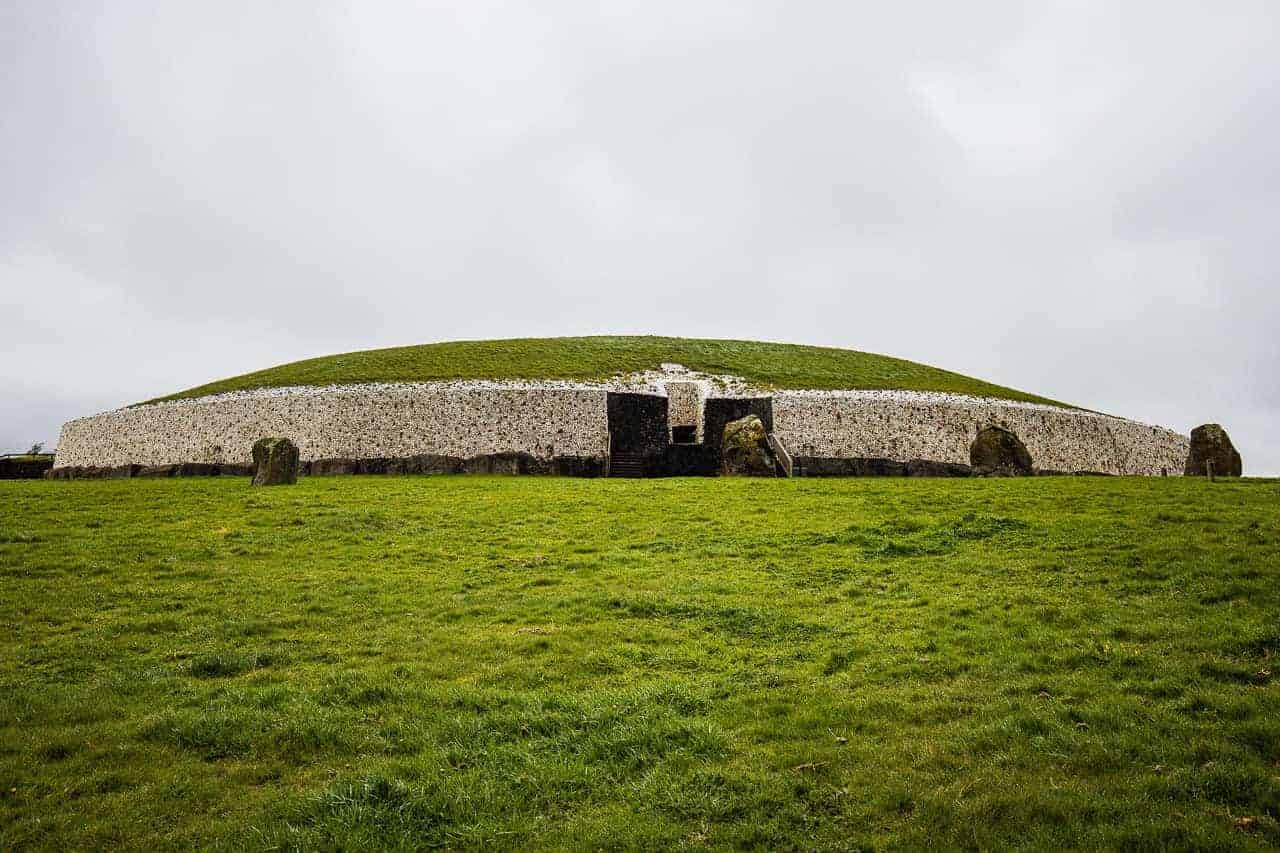
What to expect when visiting Brú na Bóinne.
Tour Overview
Visiting Brú na Bóinne means stepping back over 5,000 years in Irish history. The trip starts at the Brú na Bóinne Visitor Centre, the only entry point to these ancient sites. Through exhibitions and guided tours, you’ll learn about the people who built these tombs and their remarkable skills in architecture and astronomy.
Guided tour – my experience
The ticketing process is straightforward and offers three distinct options. I’d recommend opting for the combination ticket, priced at €18, to anyone; it grants access to both sites. This tour lasts about three hours and is worth every minute.
Despite the possibility of glimpsing both sites from the road, entry is exclusively through the Brú na Bóinne Visitor Centre, which is itself a treasure trove of information. Its impressive exhibition delves into the Neolithic people, the megalithic era, and significant events like the solstices.
Whether you explore the exhibition before or after your tour, it’s a must-see that will give you more insights into Ireland’s Ancient East!

Upon booking, the specific time you choose is when you will need to arrive at the Visitor Center (not the start of the tour). You should get about a 30-minute window before the shuttle bus leaves, but I wouldn’t stress enough that it doesn’t mean you can arrive 30 min late!
While waiting for the shuttle, I briefly explored the exhibition. You can also grab a bite at the café or browse the souvenir shop. I think the exhibition deserves a bit more time.
The shuttle bus can accommodate 24 people seated, which is the maximum number per group/time. At each stop, the bus driver gave us a time when we needed to be back, which was way enough both times.
The first stop is at Knowth, and the ride only takes about 5 minutes.

At Knowth, we were welcomed by a joyful OPW guide who took us around the site, sharing details about the ancient artworks, passageways, and life of the Knowth people. We then got the opportunity to climb atop the largest mounds where the inhabitants lived, offering a unique perspective of the site and a view over the Boyne Valley.
Before heading back to the bus, we stepped inside an OPW building, where we watched an engaging video presentation about Brú na Bóinne excavation. It was really interesting. There are accessible facilities on site for anyone who needs a toilet break.
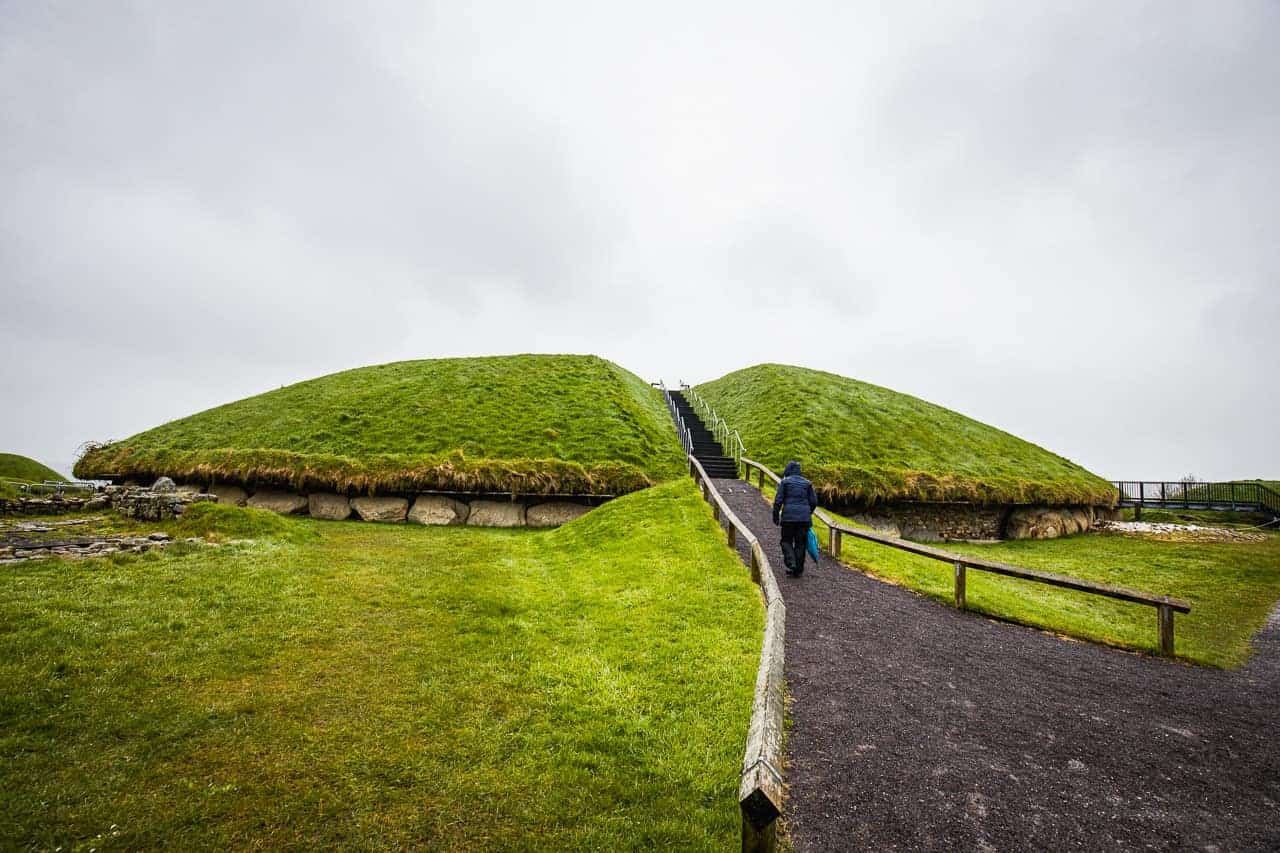
The next stop is another 5-minute drive. Once again, we were welcomed by an OPW guide who walked us to the entrance of Newgrange’s mound. Because we have been given a lot of information about the Boyne Valley so far, the guide narratives are quite brief and mostly about the building itself and practical information about the next part of the tour: Entering the passage, Tomb!
Due to space constraints within the passage tomb, our group was in 2. While the first group entered the passageway, the second group could independently walk around the mound and discover the site. It was about 10/15 min. That was a nice opportunity to take photos and discover Newgrange at my own pace.

Once it was our turn to enter Newgrange, we followed each other through a narrow passageway with low ceilings to the final chamber. The walk was less than one minute, and as someone who usually doesn’t feel well in confined spaces, I felt okay. But if your claustrophobia is much stronger than mine, you will be offered to either enter last (so you can escape more easily) or stay outside.
Inside the chamber, we were shown a simulation of the winter solstice light phenomenon. It was a great experience that helped us visualize the ingenuity of Newgrange creators. I don’t have any photos from inside the chamber, as taking any without a permit is prohibited.
After the Newgrange visit, the shuttle bus will take you back to the visitor centre, where you can round off the day with reflections over a hot drink or a final stroll through the exhibition and shop.
The entire experience is thoughtfully curated, ensuring accessibility, engagement, and a deep appreciation for these ancient wonders. My visit was not just a tour but an opportunity to connect with Irish history, meticulously facilitated by the Brú na Bóinne Visitor Centre and its dedicated staff.

Deep Dive into Knowth & Newgrange
Brú na Bóinne is Ireland’s richest archaeological site, with more than 150 monuments. The Neolithic sites of Knowth and Newgrange stand out as remarkable windows into Ireland’s ancestors’ lives, beliefs, and artistry.
The Neolithic era, or New Stone Age, marks a pivotal period in human history, characterized by the advent of agriculture, the development of settled communities, and significant advancements in technology and art.
Ireland’s Neolithic landscapes are rich with evidence of this transformative epoch.
Newgrange Passage Tombs
Newgrange is arguably the jewel in the crown of Neolithic Ireland. Built around 3200 BC, it predates both Egyptian pyramids and Stonehenge!
The passage tomb is renowned for its alignment with the winter solstice sunrise, which showcases the builders’ engineering and astronomical knowledge.
Fascinating Facts about Newgrange
- Newgrange was rediscovered in 1699 and has undergone several archaeological excavation and restoration phases. The most significant modern excavation and restoration work, led by Professor Michael J. O’Kelly, took place between 1962 and 1975 when the roof box and entrance were reconstructed to allow the winter solstice phenomenon to be observed as it would have been in Neolithic times.
- The construction of Newgrange is believed to have required a large community working together. It’s estimated that moving the stones and building the tomb would have taken a group of people about 30 years
- Inside the tomb, remains of both cremated and uncremated human bones have been found, suggesting that Newgrange may have served as a burial site. However, the specific rituals or beliefs surrounding these burials remain a subject of speculation and study.
- Newgrange covers an area of about one acre (approximately 4,046 square meters). The mound is 85 meters (279 feet) in diameter and 13.5 meters (44 feet) high, making it a significant prehistoric monument visible from afar in the Boyne Valley landscape.
- The passage leading into Newgrange is about 19 meters (62 feet) long and leads to a cruciform (cross-shaped) chamber inside the mound.
- Surrounding Newgrange is a ring of 97 kerbstones, large stones positioned at the base of the mound. These stones, some richly decorated with megalithic art, contribute to the site’s overall circumference and aesthetic presence.
- The construction of Newgrange involved transporting and placing approximately 200,000 tons of material. Some rocks were sourced from the Wicklow Mountains and the Mourne Mountains, which are more than 50km away!
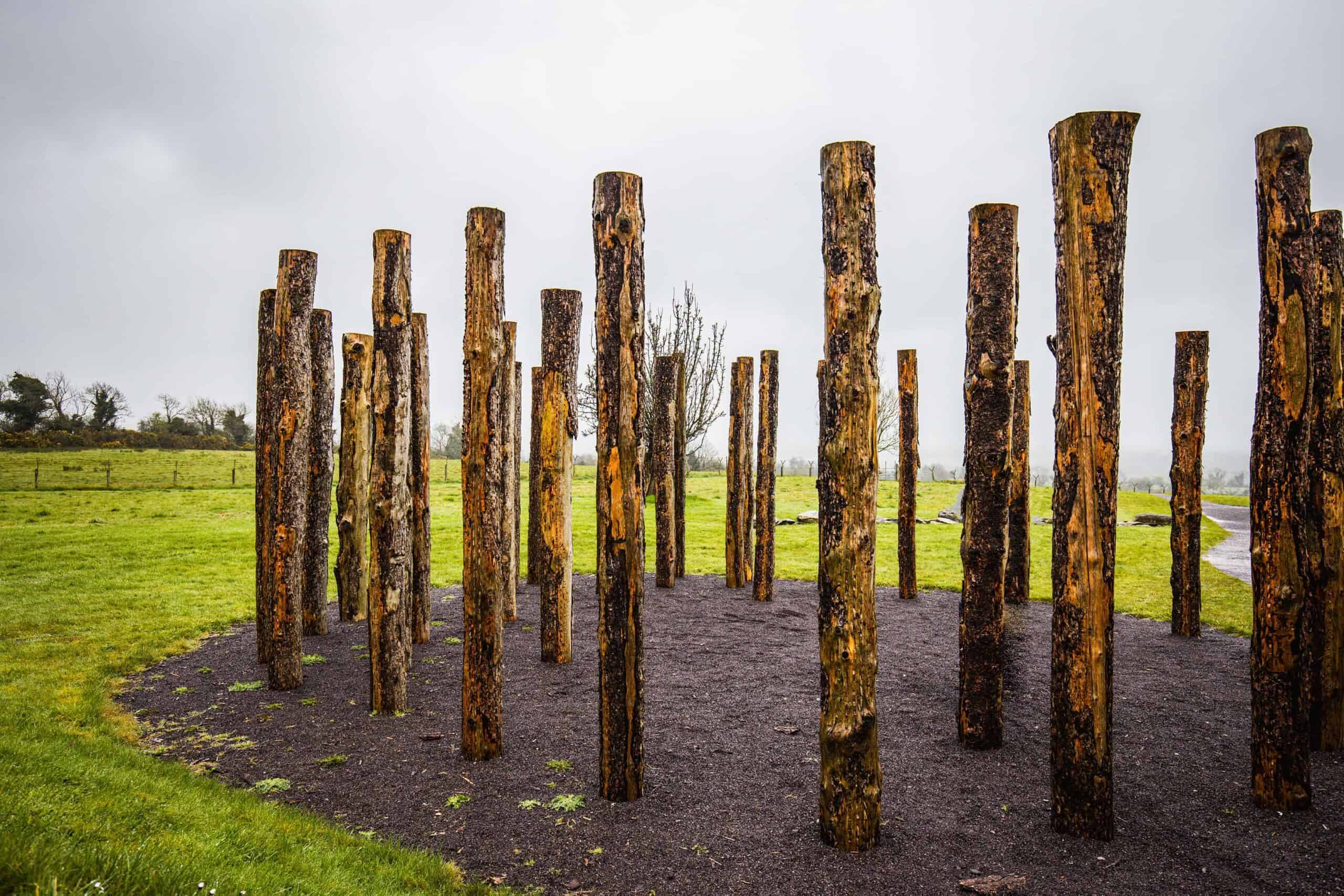
The Builders and Age of Newgrange
The people who built Newgrange were part of a wider Neolithic transition across Europe. They moved from a hunter-gatherer lifestyle to settled farming. They grew crops such as wheat and barley and raised animals like cattle, sheep, and pigs.
The effort required to build Newgrange suggests a well-organized society with advanced construction, engineering, and astronomy knowledge. The builders lived in nearby settlements, possibly consisting of wooden houses or clustered huts.
These communities would have been closely knit, with shared labour and resources essential for survival and undertaking monumental projects like Newgrange.


Knowth
Knowth is another eminent Neolithic site within the Brú na Bóinne complex, consisting of one large central tomb and 18 smaller satellite tombs. It hosts two passageways (from East and West) that, interestingly enough, do not connect.
Contrary to Newgrange, these passageways are unfortunately not open to the public due to safety.
The monument is renowned for its spectacular collection of megalithic art, housing the largest assemblage of Neolithic rock art in Western Europe.
Over 120 stones have been identified at the site, out of which 97 feature intricate carvings of spirals, lozenges, and other geometric motifs. These carvings offer invaluable insights into the symbolism and culture of Neolithic Ireland.
Knowth is also the largest passage tomb in Europe! There are so many reasons to visit Knowth, too.

Newgrange vs Knowth – Which should you choose?
Newgrange and Knowth are both outstanding monuments. Despite their proximity and shared cultural heritage, they have distinct characteristics and appeals.
Newgrange is the place to go if you are particularly interested in astronomy. If you’re fascinated by Neolithic art and want to see the largest collection of megalithic rocks in Europe, there is no doubt that Knowth is the place to go.
Below are more details on both sites to help you choose if you must!
Newgrange Pro & Cons
- Access to the inner Chamber! This is a real plus in itself because only the Newgrange chamber is accessible to the public.
- Astronomical Significance: Newgrange is famously aligned with the winter solstice sunrise and is the place to go for anyone interested in astronomy and engineering.
- Artistic Display: While Newgrange does feature some megalithic art, including the renowned triple spiral design on the entrance stone, it has fewer examples than Knowth.
- Myth and Legend: Newgrange is steeped in Irish mythology, particularly in tales about the Tuatha Dé Danann, the ancient gods of Ireland, and is said to be the burial place of various Irish kings.
Knowth Pro & Cons
- Largest Collection of Megalithic Art: Knowth boasts the largest collection of Neolithic rock art in Europe, if not the world, with over 200 decorated stones found at the site.
- Size and Structure: Knowth is notable for being the largest passage tomb complex in Europe. It consists of one large central tomb and 18 smaller satellite tombs.
- Dual Astronomical Alignments: Unlike Newgrange’s singular alignment with the winter solstice sunrise, Knowth’s main passage is aligned with the equinoxes, where the rising and setting sun illuminates its chambers twice a year.
- Limited Access to Inner Chambers: Visitors to Knowth can explore the site extensively, but access to the inner chambers is forbidden. You can walk to the top of the mound, which you can’t do at Newgrange.
What can you do and see near Newgrange & Knowth?
Dowth
Dowth, less famous but equally fascinating, is another crucial part of the Brú na Bóinne complex. Dowth is not as extensively excavated or restored, unlike its more famous neighbours, offering a more untouched glimpse into the Neolithic past.
Visitors can appreciate the serene, unspoiled landscape that envelops this ancient passage tomb, making it a compelling site for those interested in exploring the depth of Ireland’s ancient history.
Battle of the Boyne
The Battle of the Boyne site commemorates one of the most significant battles in Irish history, fought in 1690 between King James II of England and his son-in-law, William III.
This pivotal battle, across the River Boyne near Drogheda, had lasting effects on Irish, British, and European history.
Today, visitors can explore the beautiful battlefield, complete with a visitor centre that offers insightful exhibitions detailing the battle’s history, its protagonists, and its impact on Ireland and beyond.
Trim Castle
Trim Castle is the largest Anglo-Norman castle in Ireland. Constructed over 30 years in the late 12th century, this imposing structure dominates the landscape of Trim, County Meath. It is famous for its unique 20-sided tower and has been featured in movies like “Braveheart.”

Hill of Tara
The Hill of Tara is one of Ireland’s most sacred and historic sites. It was the ancient seat of the High Kings of Ireland.
Its landscape has numerous archaeological remnants, including the famous Stone of Destiny (Lia Fáil), where the kings were crowned.
The site’s panoramic views and spiritual significance draw visitors who come to walk among the earthworks and monuments that span over 5,000 years of human activity.
Slane Castle
Slane Castle is renowned for its historic architecture, sprawling grounds, and as a venue for major music concerts. The castle is owned by the Conyngham family since the 18th century and boasts a fascinating history, beautifully appointed rooms, and an intriguing art collection.
Visitors can enjoy guided tours of the castle, exploring its history and architecture, before visiting the on-site distillery for a taste of local craftsmanship.
The castle’s events, including concerts featuring world-renowned artists, make it a vibrant cultural hub in the heart of County Meath.
FAQ

ARE YOU ON PINTEREST?
What about saving this post to your Pinterest board?
Click on the photo to save this blog post for later. Follow Travel Ireland Today’s boards to see our latest pins.

I help you explore Ireland like a local with insider tips, detailed itineraries, and practical advice.
HEY THERE! I’M JEN…
Funder, Author & Photographer behind travelirelandtoday.com
Ireland has been my home for the last 12 years. Before settling here, I spent years backpacking around the globe, visiting 65+ countries. Along the way, I discovered my love for hiking, photography, and crafting budget-friendly itineraries.
Through this website, I share the best things to do and see in Ireland, detailed hiking guides, and practical tips to help you plan your perfect Irish adventure. Let’s make your trip unforgettable!


Muchas gracias por tu impresionante informe. viajo en octubre para Irlanda y guardé el vínculo de este artículo dada su utilidad. Como vamos con auto iremos al centro tal cual lo señalas y veremos como podemos aprovecharlo dado que apenas entendemos inglés y creo que allí no tienen servicios en otros idiomas. haremos lo posible para aprender por nuestra todo lo que podamos. Nuevamente gracias, es un trabajo estupendo
Hello Nestor, I believe the tour is indeed just in English but there are Audioguides available for free in Spanish for the exhibition only. Maybe ask at the center if they have a leaftlet in Spanish too. Otherwise, you can maybe find some Audio guide Apps, though I don’t have any to recommend in spanish, I am sorry.